Tackling Condensates
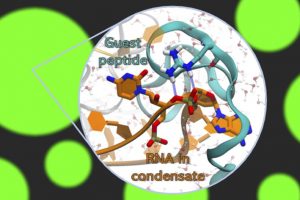
In recent years, scientists have identified a new type of compartment in cells, often called a condensate. These condensates form when weakly interacting proteins and RNA molecules segregate themselves from…
Read moreIn recent years, scientists have identified a new type of compartment in cells, often called a condensate. These condensates form when weakly interacting proteins and RNA molecules segregate themselves from…
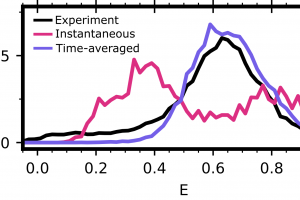
Read moreOur new work shows how to predict the results of single molecule experiments from large simulations, like those performed on Folding@home. Showing that simulations are consistent with experiments is important…
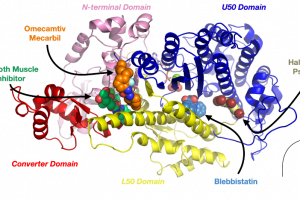
Read moreThe goal of precision medicine is to utilize our knowledge of the molecular causes of disease to better diagnose and treat patients. In the precision medicine framework, diseases are subdivided…
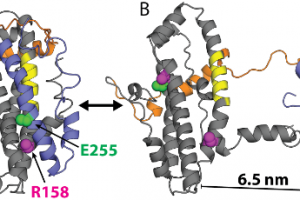
Read moreA number of active projects on Folding@home right now aim to understand how different forms of the protein apolipoprotein E (ApoE) determine one’s risk of developing Alzheimer’s disease. Alzheimer’s disease…
Read moreFolding@home has long sought to understand how proteins self-assemble, or fold, into their functional structures and what the functional implications of dynamics within the context of a folded protein are.…
Read moreWhen it comes to designing novel drugs, achieving specificity is a major challenge. An effective drug must bind tightly to its target protein while avoiding unwanted side effects that can…
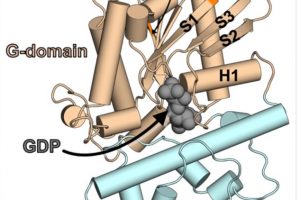
Read moreG proteins are essential molecular players in the intricate symphony of cellular signaling. From our vision to our sense of smell, neurotransmission to cell growth, G proteins are at the…
Read moreNew projects from the Voelz lab focus on assessing how well modern force fields can model proteins, the biological machines of the cell.
Read moreRev up your GPUs and help us in the final stretch of nominating a patent-free oral antiviral for preclinical studies!
Read moreFolding@home helps experimental collaborators understand mutations that drive increased fitness of SARS-CoV-2 mutants.
Read more