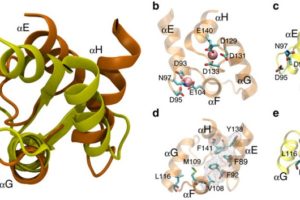
Mechanistically distinct cancer-associated mTOR activation clusters predict sensitivity to rapamycin.

Genomic studies have linked mTORC1 pathway-activating mutations with exceptional response to treatment with allosteric inhibitors of mTORC1 called rapalogs. Rapalogs are approved for selected cancer types, including kidney and breast cancers. Here, we used sequencing data from 22 human kidney cancer cases to identify the activating mechanisms conferred by mTOR mutations observed in human cancers and advance precision therapeutics. mTOR mutations that clustered in focal adhesion kinase targetin…

Read more
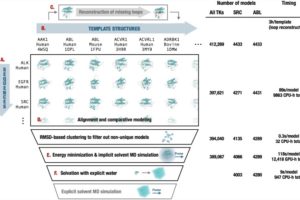
Markov models of the apo-MDM2 lid region reveal diffuse yet two-state binding dynamics and receptor poses for computational docking.

MDM2 is a negative regulator of p53 activity and an important target for cancer therapeutics. The N-terminal lid region of MDM2 modulates interactions with p53 via competition for its binding cleft, exchanging slowly between docked and undocked conformations in the absence of p53. To better understand these dynamics, we constructed Markov State Models (MSMs) from large collections of unbiased simulation trajectories of apo-MDM2, and find strong evidence for diffuse, yet two-state folding and b…

Read more

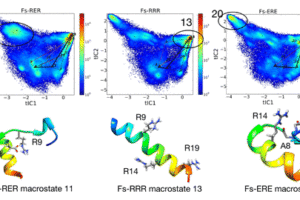
Insights into Peptoid Helix Folding Cooperativity from an Improved Backbone Potential.

Peptoids (N-substituted oligoglycines) are biomimetic polymers that can fold into a variety of unique structural scaffolds. Peptoid helices, which result from the incorporation of bulky chiral side chains, are a key peptoid structural motif whose formation has not yet been accurately modeled in molecular simulations. Here, we report that a simple modification of the backbone φ-angle potential in GAFF is able to produce well-folded cis-amide helices of (S)-N-(1-phenylethyl)glycine (Nspe), consi…

Read more